

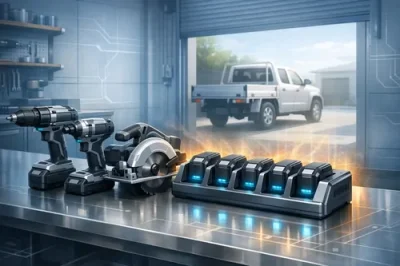
Rechargeable gear is convenient, but storage and charging practices can affect your risk profile
0
The information on this website is general in nature and does not take into account your objectives, financial situation, or needs. Consider seeking personal advice from a licensed adviser before acting on any information.
Recent industry attention on lithium-ion battery fires is a timely reminder for Australian tradies that rechargeable gear is now a core business risk, not just a convenience.
Cordless drills, grinders, saws, laser levels, test equipment, phones, tablets and battery packs are part of everyday work, but they also introduce fire, theft and interruption exposures that can be easy to overlook.
The issue is not that tradies should avoid battery-powered tools. For many trades, they are essential for productivity and mobility. The practical point is that batteries can fail if they are damaged, overheated, poorly charged, stored incorrectly or paired with unsuitable chargers. A fire that starts in a ute, van, garage, shed or workshop can quickly become much bigger than the cost of one tool.
For small trade businesses, the insurance angle is straightforward: the way tools and batteries are stored, transported and charged can affect both the likelihood of a claim and the evidence needed if something goes wrong. A damaged battery left charging overnight near flammable materials may create a very different claims conversation from a well-documented setup with compliant chargers, clear storage practices and regular checks.
This also links to sums insured. Many tradies add tools gradually over years, which means the replacement value of a kit can be far higher than expected. If batteries, chargers and specialist equipment are not included in your asset list, your cover may not reflect the real cost of getting back to work. It is worth taking time to estimate realistic replacement values before renewal, especially if your crew has grown or you have upgraded to higher-end cordless systems.
Good risk management does not need to be complicated. Useful steps include:
Using manufacturer-approved chargers and avoiding damaged leads or battery casings.
Charging batteries in a clear, ventilated area away from fuels, solvents, timber dust and packaging.
Avoiding overnight charging where there is no supervision or fire detection.
Keeping purchase records, serial numbers and photos of major tools and battery systems.
Checking whether tools are covered in vehicles, on site, in transit and at your workshop.
The bigger lesson is that tool insurance is not only about theft from a locked ute. Fire, accidental damage, storage conditions, exclusions and sub-limits can all matter. If your setup includes a workshop, employees, subcontractors or multiple vehicles, an insurance broker can help review how public liability, tools, contents and vehicle cover work together.
Battery-powered tools are here to stay. Treating them as part of your wider business risk plan can help protect your equipment, your cash flow and your ability to keep jobs moving after an unexpected incident.
Please Note: We do not endorse any specific products or companies. Some content is sourced from third parties, including press releases, and may not be independently verified for accuracy or completeness.
Fresh attention on cyber incidents across Australian businesses is a timely warning for restaurants, cafés and takeaway operators. Hospitality venues may not always see themselves as data-heavy businesses, but modern food service increasingly depends on connected systems: point-of-sale terminals, booking platforms, delivery apps, QR ordering, loyalty databases, rostering tools and cloud accounting. - read more
Recent heavy vehicle compliance activity has again put fatigue management near the top of the risk agenda for Australian transport operators. While enforcement is usually framed as a road safety issue, it also has a direct insurance dimension. Insurers assessing truck insurance risk increasingly look beyond the vehicle itself and ask how well the business controls driver behaviour, scheduling pressure, maintenance downtime and record-keeping. - read more
APRA’s latest general insurance data has again highlighted a point many Australian tradies are already feeling at renewal time: a healthier insurance sector does not necessarily translate into simple or immediate premium relief for small businesses. While insurers continue to operate with stronger capital buffers and improved underwriting discipline, the costs sitting behind many policies remain under pressure. - read more
Fresh complaints reporting from the Australian Financial Complaints Authority has put insurance service standards back under the microscope, with claim delays, communication issues and disputed outcomes continuing to feature in the wider financial services complaints landscape. For beauty salon owners, skin clinics, nail technicians and mobile beauticians, the lesson is practical: the moment a loss occurs is not the best time to discover that records are incomplete, policy wording is unclear or a treatment has not been properly disclosed. - read more
New South Wales insurance buyers may be heading for an important change as reform of the Emergency Services Levy continues to attract attention across the insurance sector. The levy has long been added to many insurance premiums in NSW to help fund emergency services, and insurers have argued that this approach makes cover more expensive for households and businesses that choose to insure. - read more
Farmers are no strangers to the whims of nature. The weather, with its unpredictable temperament, can have a profound impact on farming operations. A single storm can lay waste to crops, while a prolonged drought can jeopardize the health of livestock and lead to severe economic strain. Understandably, the uncertainty that weather brings is one of the largest variables in a farmer's success equation. - read more
Welcome to our in-depth exploration of Machinery Breakdown Insurance—a safety net that's becoming increasingly important for the modern Australian farmer. Whether you're involved in cropping, dairy, or livestock, your equipment is the backbone of your operation. As farming technology evolves, the machinery becomes more sophisticated, and unfortunately, the more complex a system is, the more that can go wrong. This is where Machinery Breakdown Insurance comes into play. - read more
Australia's agricultural sector stands as a testament to the resilience and ingenuity of its farmers. Yet, this stalwart industry faces one of its greatest challenges: climate change. Rising temperatures, erratic weather patterns, and extreme events, from droughts to floods, are now common hurdles on the landscape of Australian farming. - read more
For generations, farmers have faced the challenge of protecting their crops from an array of threats, such as pests, diseases, and extreme weather. Traditional crop protection strategies have relied heavily on blanket approaches, as in using widespread pesticide application, or generalized irrigation systems, regardless of the varying needs across a field. While these methods have had their successes, they also come with limitations in efficiency, environmental impact, and the precision needed for optimal crop health and yield. - read more
Hobby farms, small acreage properties and lifestyle blocks can sit between standard home insurance and commercial farm insurance. This guide explains when a property may need farm-style cover, what risks often fall outside home insurance, and how hobby farm cover can differ from commercial farm policies in Australia. - read more
Knowledgebase
Insurable Interest: A financial or other kind of interest in the insured item or person, necessary for a valid insurance contract.
No comments yet. Be the first to share your thoughts.